
Richardson Previous Residents by Era
One address can leave records in several places. The first choice depends on the period and on which side of the Dallas and Collin county line holds the parcel. Deed indexes establish recorded land transfers. Telephone directories and reverse listings offer dated address clues. Census schedules can place a household in a larger time frame, while permits, newspapers, probate, and obituaries can explain a change between the major sources. None of these sources alone proves every person connected to a house.
| Address-history source | Verified era | Where to use it | What it can show |
|---|---|---|---|
| Dallas real-estate index | County describes 1846-current digitization | Dallas Official Records, counter, or Central Records | Recorded parties, instrument details, and legal-description trail |
| Collin Historical Records | 1843-1975 | PublicSearch Historical Records and county clerk | Older land-record route requiring legal-description checks |
| Greater Dallas white pages | Verified 1974 scan | UNT Portal to Texas History | Printed name, Richardson address, and telephone clue |
| Regional Polk’s volumes | Verified digitized pages from 1973, 1974, and 1976 | UNT Portal and local-history resources | Regional directory lead; uninterrupted local run is not verified |
| Federal census | 1790-1950 public images; 1890 mostly lost | NARA and library databases | Household, age, birthplace, and street context |
| City permit inquiry | Current portal; historical cutoff not stated | City of Richardson permit inquiry | Address-tied application or work event |
The title trail belongs to the county clerk, while the household trail usually needs a directory, newspaper, or census comparison. Keep those roles separate from the first note onward.
Start Richardson Past Residents at CAD
The current parcel record gives the backward search a stable starting point. For a Collin-side address, Collin Central Appraisal District can search owner name, street number, street name, Property ID, Geographic ID, subdivision, tax year, and legal description. Its field layout can also include deed book or page, deed number, deed date, deed type, situs fields, and a separate mailing address. The mailing address may identify where notices go, but it should never replace the situs address as evidence of a person’s location.
For a Dallas-side parcel, use Dallas Central Appraisal District, then confirm the county with the parcel result before opening the recorder index. Record the modern street number and name, ZIP, county, parcel or geographic ID, legal description, subdivision, lot or block, listed owner, and deed reference. This one-address worksheet makes it possible to recognize a replat, a different lot number, or a former street name later in the trail.
Note: Richardson’s city limits cross two counties, so the county comes from the parcel result rather than the city name alone.
Trace Richardson Previous Residents Through Deeds
A chain of title follows recorded transfers backward from today’s legal party. Begin with the parcel’s listed owner and legal description, then find the most recent purchase instrument in the appropriate county index. Copy the grantor, grantee, instrument and recording dates, document type, and legal description. Search the seller from that instrument as a grantee in an earlier period. Repeating that relationship is more reliable than repeatedly typing the modern street address.
The Dallas County Official Records advanced search supplies party, grantor, grantee, recorded-date, instrument-date, document-number, lot, block, and legal-description filters for a Dallas-side trail.
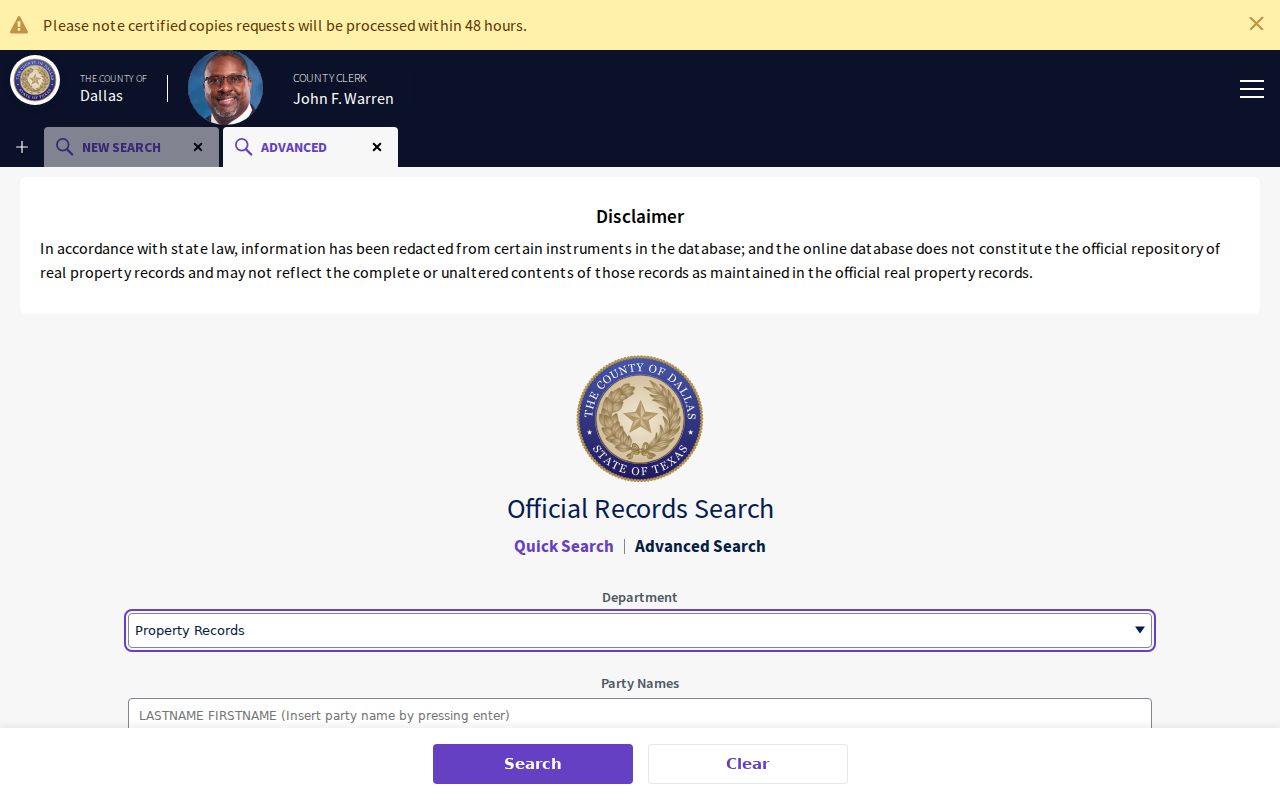
The official form supports a focused comparison of legal land wording and dated parties. Enter party names surname first as the portal instructs, then confirm the returned instrument against the parcel before adding it to the chain.
- Find the current parcel and copy its legal description, deed reference, county, and situs address.
- Open the current legal party’s most recent purchase instrument in the Dallas or Collin land index.
- Compare the lot, block, subdivision, or other legal description to the parcel before accepting the document as a match.
- Use the grantor from that transfer as a grantee in an earlier date range, then repeat the comparison.
- When the description changes, find the plat, replat, declaration, or annexation record that bridges the older and newer land identity.
- Grantor
- The party transferring an interest in a recorded instrument.
- Grantee
- The party receiving an interest in that instrument.
- Chain of title
- The sequence of recorded transfers connected through the same land identity.
- Legal description
- The lot, block, subdivision, or other formal land wording that helps match a deed to a parcel.
A recorded party may be a trust, estate, lender, title company, or entity. Read the document type instead of treating every name as a past household member.
Richardson Past Residents in Collin Records
Collin County separates current land searching from a historical route. The county’s land-search instructions direct researchers to search a name or document number, obtain the legal description through CCAD, sort results by recorded date, and verify the legal description before buying an image. For 1843 through 1975, choose Other Services and then Historical Records in the county’s PublicSearch system. This split matters when an address trail stops at an older transfer.
A result can first appear as an unofficial watermark view, with a printable PDF available through the cart and registration process. Plats use the Property Records and Plats path with the subdivision name. The county warns that its online property-record database is not the official repository and may not be complete, so a difficult record calls for the clerk counter or a documented request rather than an assumption that the transfer is missing.
Richardson Previous Residents in Dallas Deeds
The Dallas County Official Records quick search can search indexed material with a search term and recorded-date filters. It offers index-only and index-plus-full-text modes. The quick page explains that two words in index-only mode are treated as separate index words, while OCR full-text can help when an image is readable. Advanced search adds grantor, grantee, party, legal description, and document fields for a more precise deed trail.
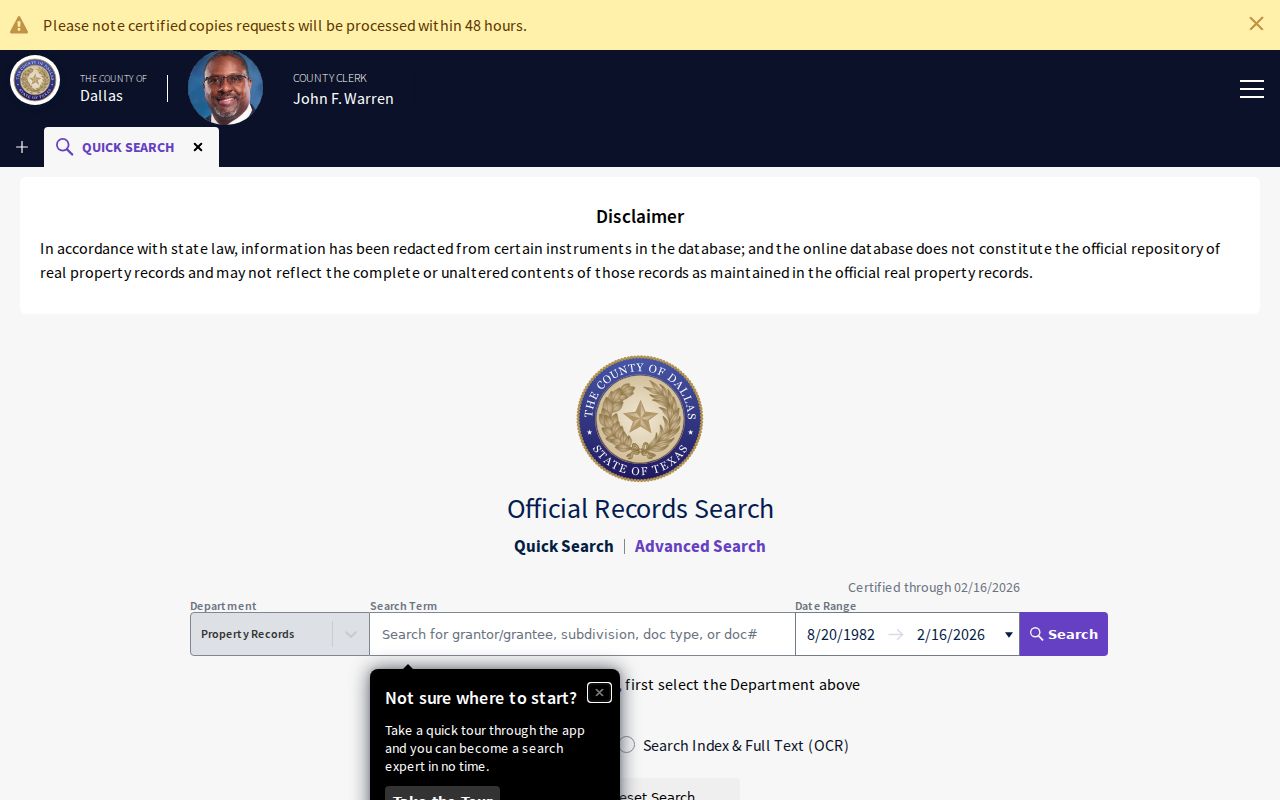
The screenshot shows the official quick-search entry point. The online index is only one access channel. Dallas Central Records describes historic deed, commissioner, and probate books and microfilm, while some civil and probate availability follows office-only windows. The Recording Division also accepts a mail document request that identifies the grantor, grantee, instrument number, document type, or property address.
Plain copies are listed at $1 per page, with $5 added for certification, under the researched Dallas request form. Confirm current pricing and the required payment method with the clerk before sending a request.
Find Richardson Past Residents Between Deeds
Deeds track recorded interests, so dated directories help fill the periods between transfers. The 1974 Greater Dallas white-pages scan has a Richardson section with printed names, street addresses, and telephone numbers. It is a concrete address clue for that year, not a current record and not a complete household census. Search surname variants, initials, married names, and nearby alphabetical entries when an OCR search splits a name.
The scan demonstrates the kind of dated listing that can sit between two recorded transfers. Richardson Public Library also reports old phone books and local-history files, though a complete Richardson reverse-directory publisher and year run was not verified. For the collection details and access limits, use the Richardson Directory Book rather than assuming every year exists online.
Pair Richardson Directories With Census Years
Pair the date on a directory entry with the nearest public federal census, then test the same address and family details across both sources. The National Archives releases census images under a 72-year rule, making 1950 the newest complete public federal census in the researched material. Census pages can provide a household frame, but they are not current proof. The 1890 schedules are mostly destroyed, so a missing 1890 census result does not end an address history.
- Write down the exact year and printed address from the directory or phone-book entry.
- Check the closest available census year for household names, ages, birthplace, and street context.
- Search a newspaper issue near the directory year for notices, announcements, or an obituary lead.
- Return to the deed chain and test whether the same legal description or owner timeline fits the address evidence.
Newspapers, probate files, and an estate deed can close a trail when an address disappears from later listings. Sensitive probate or court material may be restricted, so ask the clerk how to request an accessible file rather than expecting every page online.
Use Richardson House-History Help
Richardson Public Library is the local human-assisted channel when an index runs thin. City material says librarian Stacey Davis helps research land, streets, buildings, and regions with old newspapers, photographs, maps, deeds, and City Council minutes. Bring the parcel or legal description, an address spelling, and an era window. That gives the librarian a concrete starting point without asking the library to create a new record.
The library’s digital resources include Ancestry Library Edition, HeritageQuest, fold3, NewspaperArchive, the Richardson Echo Historical Archive, Portal to Texas History, and Texas Digital Sanborn Maps. Ancestry Library Edition is in-library only, and access conditions for licensed sources can change. Texas Digital Sanborn Maps are described as a collection spanning 1867 to 1970, but exact Richardson sheet years were not verified. A map can help interpret building footprint and street context, not identify a past household by itself.
Note: The library is temporarily at the municipal campus during renovation, so call before a local-history visit.
Bridge Old Richardson Address Names
Some past-resident searches fail because the road name changed, not because the address disappeared. Richardson’s official historical material documents Smith Street as present-day East Main and Richardson Pike as Greenville Avenue. Search each name pair alongside the legal description, subdivision, lot, block, and directory year. This uses a documented name bridge while avoiding an unsupported claim that the city underwent a broad numerical renumbering.
Richardson’s 1873 railway settlement, 1874 post office, 1925 incorporation, and later annexation of Buckingham add useful geographic context to older documents. County deed records reach back before the city’s incorporation, so an old land trail may begin in Dallas or Collin records rather than in a city file. A plat or city-history record can be the link when a modern street name does not appear in an older directory.
Richardson Previous Residents Research Limits
Past residents and past owners are not interchangeable. A deed identifies a recorded legal transfer, while a directory entry is a dated listing and a census page is an enumeration-period record. Public sources do not offer a complete list of every person who may have been at an address. Protected address programs, sealed files, sensitive vital records, and restricted motor-vehicle data create necessary gaps in the record trail.
When an online source stops, use the documented fallback channels: the county clerk counter or mail request, Richardson Public Library local history, and a written Texas Public Information Act request for an existing city or county record that is not indexed online. A request cannot require an office to create a person list or disclose protected information.